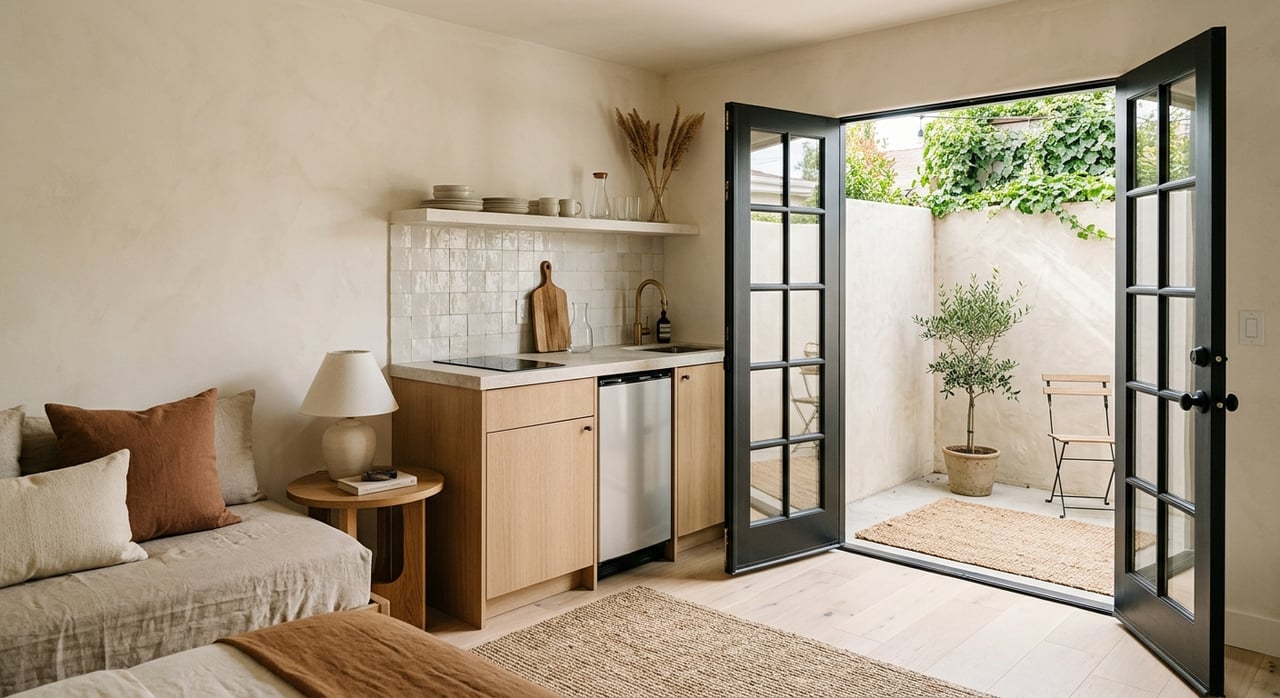
If you own property in Culver City, an ADU can look like a smart way to add flexibility and create rental income. But the real opportunity is not just building any unit. It is building the right unit for local rules, realistic costs, and the kind of rent the market can support. In this guide, you’ll get a practical look at how ADUs work in Culver City, what shapes rental potential, and where small investors and homeowners often find the strongest value. Let’s dive in.
Why Culver City stands out for ADUs
Culver City is a workable ADU market because the rules generally allow ADUs across residential settings, and the approval path is ministerial. That means applications are reviewed against objective standards rather than a discretionary process. For homeowners and small investors, that usually creates a more predictable path than in markets with heavier case-by-case review.
The city also adds a helpful layer through its pre-approved ADU program. Culver City offers pre-approved studio, one-bedroom, and two-bedroom plans at 468, 637, and 806 square feet. These plans are not site-specific, but they can reduce some early design friction and help you move into the permit stage with a clearer framework.
Culver City ADU rules to know
Before you underwrite rental income, you need to understand the basic rules that shape what you can build and how you can use it.
Where ADUs are allowed
In Culver City, ADUs are allowed in zones that permit single-family or multi-family residential use. The city does not require a minimum lot size for an ADU. ADUs can be created within, attached to, or detached from the primary home or an accessory structure.
JADUs are also allowed, with a maximum size of 500 square feet. For many owners, that creates another option when the goal is to add a smaller unit with less construction than a full detached build.
Size and setback limits
Size is one of the most important design constraints in Culver City. Attached ADUs can be up to 850 square feet for a one-bedroom unit or 1,200 square feet for a unit with two or more bedrooms, or 50 percent of the primary dwelling’s square footage, whichever is less.
Detached ADUs can also reach 850 square feet for one bedroom or 1,200 square feet for two or more bedrooms. Side and rear setbacks are generally 2 feet in certain nonresidential, street, or alley conditions and 4 feet when abutting residential zones. Those objective standards matter because they directly affect whether a detached layout will fit your lot cleanly.
Parking and owner-occupancy
Culver City does not require parking for ADUs under its current rules. Owner occupancy is also generally not required. For many property owners, those two points materially improve the feasibility of adding a legal rental unit.
Short-term rental limits
This is one of the biggest points for investors to understand. In Culver City, ordinary ADUs and JADUs cannot be rented for fewer than 30 days. In practical terms, you should model an ADU around long-term leasing, not nightly or weekend turnover.
That rule changes the underwriting. If you are exploring ADU income in Culver City, the realistic strategy is usually stable monthly rent or, in some cases, furnished mid-term occupancy that still complies with the 30-day minimum.
What approval and timing look like
ADU approvals in California are meant to follow a ministerial timeline. The California Department of Housing and Community Development says applications must receive a completeness determination within 15 business days, and once the application is complete, it must be approved or denied within 60 days.
That said, you should still expect the full project timeline to run in months, not weeks. City pre-approved plans can reduce some front-end friction, but they do not eliminate site-specific review, plan check, permit issuance, construction, or the certificate of occupancy required before move-in.
Current California and Los Angeles ADU timeline guides suggest full projects often land in roughly the 8- to 18-month range from first call to final sign-off. Garage conversions are often on the faster end, while detached new construction usually takes longer.
What an ADU may cost in Culver City
Construction cost is where many ADU plans either become compelling or stop penciling. In the broader Los Angeles market, detached ADUs are often estimated around $280 to $400 per square foot. Attached ADUs tend to run about $260 to $380 per square foot, garage conversions around $250 to $375 per square foot, and JADUs about $200 to $350 per square foot.
Garage conversions often stand out because the shell already exists. If the structure is sound, you may avoid some foundation, framing, and roof costs, which can make this one of the fastest and more cost-efficient ways to add a legal unit.
Using Culver City’s pre-approved detached plan sizes as rough planning examples, the construction math looks like this before site work, utility surprises, and fees:
| Plan size | Rough detached construction range |
|---|---|
| 468 sq. ft. | $131,040 to $187,200 |
| 637 sq. ft. | $178,360 to $254,800 |
| 806 sq. ft. | $225,680 to $322,400 |
These are planning estimates, not bids. Still, they are useful because they show how quickly costs rise as square footage grows.
Why the 750-square-foot threshold matters
In Culver City, one of the most important pricing breakpoints is 750 square feet. ADUs with 750 square feet or less of interior livable space are exempt from local impact fees. Larger units are charged proportionately.
That makes compact plans especially interesting from an investor point of view. The city’s 468-square-foot and 637-square-foot pre-approved plans sit below that threshold, while the 806-square-foot option likely crosses into fee territory. If you are trying to balance build cost and rent potential, that line matters.
What rent potential looks like in Culver City
Rental benchmarks in Culver City generally cluster in the high-$2,000s to mid-$3,000s, depending on unit type and data source. Recent market trackers show studios around the low-$2,000s, one-bedrooms from the mid- to high-$2,000s, and two-bedrooms often in the low- to mid-$3,000s.
Because each rental platform uses a different mix of inventory and methodology, it is better to treat these as market ranges rather than exact comps. Still, they offer a useful framework for ADU planning.
Based on those ranges, a compact studio ADU will usually compete around the low-$2,000 range. A well-finished one-bedroom often aligns with the high-$2,000s to roughly $3,000 range. A two-bedroom may compete in the low- to mid-$3,000s, depending on size, finish, privacy, and overall presentation.
Culver City versus nearby Westside markets
Culver City is not a low-cost rental market. But compared with some nearby Westside areas, it can offer a more balanced relationship between development cost and rent potential.
Recent rental pages place average rents around $3,295 in Santa Monica, about $3,050 in West Hollywood, roughly $5,950 in Marina del Rey, and about $4,332 in Beverly Hills. That context matters because it suggests Culver City can still support meaningful rental income without requiring the highest entry price point on the Westside.
For small investors, that often makes Culver City feel more practical than some neighboring markets where land and carrying costs become harder to justify.
Which ADU type may pencil best
Not every ADU delivers the same return profile. In many cases, the strongest yield comes from a compact, efficient unit instead of the largest legal footprint.
Why smaller can work better
A larger unit may command higher rent, but not always enough to offset the extra construction cost, added fees, and longer timeline. That is why the 637-square-foot one-bedroom pre-approved plan is especially interesting in Culver City. It stays under the 750-square-foot impact-fee threshold while aiming at one of the market’s stronger rent bands for a small unit.
That does not mean a two-bedroom never makes sense. It means you should weigh the marginal rent gain against the marginal cost very carefully.
When garage conversions make sense
If you already have a structurally sound garage, conversion can be one of the most efficient paths to rental income. The shell is already there, and current Los Angeles guides identify garage conversions as one of the fastest and most affordable ADU options.
For many owners, this is the version of an ADU that best balances speed, cost control, and lease-up potential. It can be especially attractive when your lot would make detached new construction more complex.
Design choices that support rentability
In Culver City, the best rental performers are not always the most expensive units. Often, the units that lease well are the ones that feel thoughtful, private, and efficient.
Features that tend to support rentability include:
- A separate entrance
- Strong privacy from the main home
- Good sound separation
- Efficient layouts with usable storage
- Durable, clean finishes that photograph well and wear well
In many cases, these features matter more than pushing into luxury upgrades. Unless you are intentionally targeting the very top of the Westside rental spectrum, practical comfort and smart design often do more for your return than overbuilding the finish level.
Rent regulation and leasing strategy
Culver City’s rent stabilization rules are nuanced. The city says rent stabilization applies to parcels with two or more rental units built on or before February 1, 1995, and that rental units generally must be registered unless exempt.
At the state level, AB 1482 separately exempts units built within the last 15 years from both rent caps and eviction protections. In practice, a brand-new ADU is usually outside rent stabilization at launch, though registration and tenant-protection details still need to be checked carefully for the specific property.
The clearest takeaway is strategic. In Culver City, the most practical ADU business plan is usually long-term tenancy, with careful attention to registration and local compliance steps.
Is an ADU in Culver City worth it?
For many homeowners and small investors, the answer is yes, if the project is sized and priced with discipline. Culver City offers broad ADU eligibility, a ministerial approval path, and pre-approved plan options that can simplify early planning.
The strongest opportunities often come from staying compact, keeping an eye on the 750-square-foot fee threshold, and underwriting rent based on realistic long-term lease income. In other words, the best ADU strategy here is usually not the biggest unit. It is the unit with the clearest path to approval, efficient construction, and stable monthly demand.
If you are weighing a purchase, evaluating a value-add property, or deciding whether your current home has ADU upside, a local, design-aware lens can make a big difference. Casty Living helps buyers, sellers, and small investors think through value, layout potential, and market positioning with a practical Westside perspective.
FAQs
What are the short-term rental rules for ADUs in Culver City?
- In Culver City, ordinary ADUs and JADUs generally cannot be rented for fewer than 30 days, so they should be planned as long-term or compliant mid-term rentals.
What size ADU may offer the best rental potential in Culver City?
- A compact one-bedroom can be especially attractive because it may target a strong local rent band while staying below the 750-square-foot impact-fee threshold if kept small enough.
What are Culver City’s pre-approved ADU plan sizes?
- Culver City offers pre-approved new construction ADU plans at 468 square feet, 637 square feet, and 806 square feet, but each still requires an approved building permit and site-specific review.
How long does an ADU project usually take in Culver City?
- Even with a ministerial approval process, most ADU projects are better viewed as a months-long process, with many California and Los Angeles examples falling around 8 to 18 months from planning to final occupancy.
Are new ADUs rent controlled in Culver City?
- A brand-new ADU is usually outside rent stabilization at launch, but rental-unit registration and tenant-protection questions should still be confirmed for the specific property.
Is a garage conversion a good ADU option in Culver City?
- If the existing garage is structurally sound, a conversion is often one of the faster and more cost-efficient ADU paths because it can avoid some new foundation, framing, and roof costs.